
Tether has issued a "new stablecoin" - what are the differences between USDT 2.0 and USDT?




Today, Tether announced the first deployment of its new token USDT0 on Kraken's Ethereum Layer 2 network Ink, aiming to leverage LayerZero's Omnichain Fungible Token Standard to develop a cross-chain liquidity layer, simplify USDT's cross-chain transfers, and provide a seamless user and developer experience.
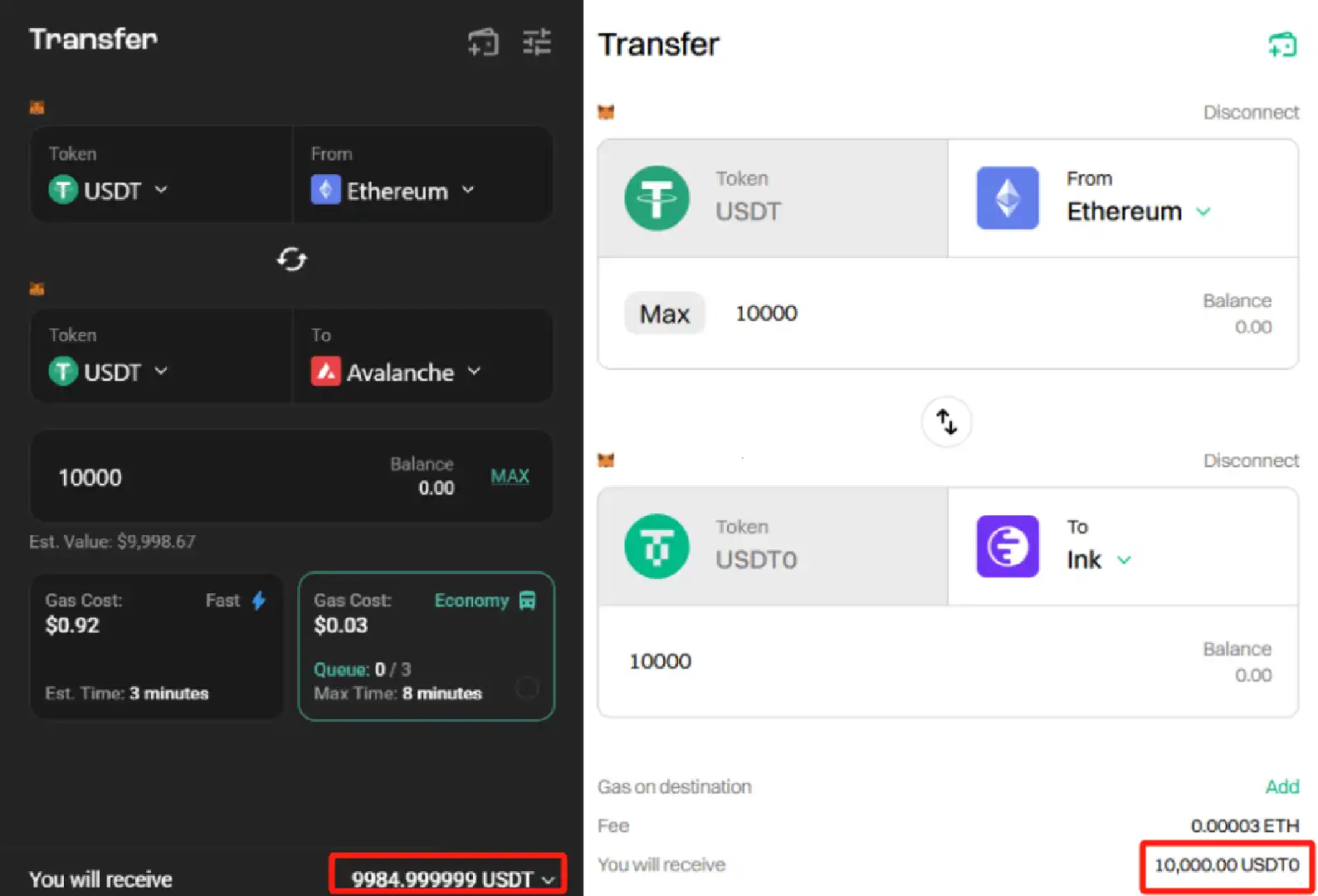
As a stablecoin previously launched by Tether, USDT has become the world's largest single stable asset. However, stablecoin liquidity is currently fragmented, with USDT on different chains unable to freely move across chains, and high cross-chain costs have always deterred ordinary investors. The introduction of USDT0 aims to address this issue. On the one hand, through collaboration with LayerZero, it significantly enhances the security of cross-chain transactions. On the other hand, it achieves zero-friction cross-chain transfers (as shown in the example below), expanding the business scope of USDT and enhancing its practicality on the blockchain.
Tether's CEO Paolo Ardoino stated: "USDT0 has brought a much-needed solution to enable the seamless circulation of USDT across different ecosystems. By enhancing interoperability and reducing barriers, it aligns with Tether's overall vision, optimizing user experience. It is truly exciting to see such innovation emerge and effectively meet market demands."
Significantly Reducing Cross-Chain Costs
USDT has always had interoperability, but in a fragmented way. Each blockchain has its own USDT, and to transfer USDT between different chains, one must rely on solutions like cross-chain bridges, i.e., burning USDT on one chain and minting it on another.
With USDT0, the situation is different: now USDT has become a single, liquid asset across various blockchains, no longer fragmented. More precisely, the same token can smoothly move between different networks.
For users, USDT0 eliminates the fragmentation issue, meaning higher capital efficiency. Below is an example of transferring 10,000 USDT from Ethereum to Avalanche (left) and now using USDT0 empowered by LayerZero (right). As seen, with USDT0, users receive exactly what they transfer cross-chain, significantly reducing expensive transaction fee losses.
Expansion Plan
Ink: The Gateway to Institutional Liquidity
USDT0 will first be launched on Ink, an L2 blockchain introduced by Kraken, one of the world's largest and most trusted cryptocurrency exchanges. Utilizing the world's largest stablecoin, USDT0 has built a seamless channel for institutional liquidity between entities.
Andrew Koller, the founder of Ink, stated: "Both USDT0 and Ink are committed to ensuring that users and developers have maximum control over their assets and can seamlessly access various opportunities. USDT0 has chosen Ink as its launch chain, which will set a new standard for the flow of stablecoin liquidity across all chains in the future."
Furthermore, USDT0 has integrated with Kraken, allowing users to deposit and withdraw USDT0 on Ink. There are plans for more integrations within the Kraken tech stack, which will set standards for USDT0's interoperability and pave the way for a world-class experience for USDT users.
Initial Partnerships and Expansion: Berachain and MegaETH
Following Ink, the initial partners for USDT expansion through USDT0 include Berachain and MegaETH, with more related announcements to be released in the coming weeks.
Berachain is a layer-one (L1) blockchain fully compatible with the Ethereum Virtual Machine (EVM), built on an innovative Proof of Liquidity (PoL) consensus mechanism. This mechanism rewards users who actively contribute resources to the network with the network's native governance token, $BGT. The integration of USDT0 on Berachain will launch on the Boyco platform, which aims to directly funnel funds into core applications on Berachain. Boyco consists of 11 decentralized applications and 15 asset issuers (including USDT0) and serves as an ideal channel for yield-seeking reserves on Berachain. The Boyco treasury has already attracted over $1.5 billion in deposits, and with the launch of official projects and the addition of high-value assets like USDT0, this number is expected to grow significantly.
MegaETH is the first real-time blockchain capable of processing 100,000 transactions per second with a sub-10-millisecond block time, while inheriting Ethereum's security. MegaETH looks forward to leveraging USDT0 in a wide range of DeFi applications and payment products. Combining real-time applications with Tether's distribution capabilities will accelerate the adoption of the next wave of cryptocurrencies.
Overall, USDT is the world's largest stablecoin and the most sought-after on-chain asset by users and the blockchain itself. USDT0 is a scalability solution for USDT that addresses the issue of high cross-chain transaction costs, making USDT and even the entire cryptocurrency ecosystem more user-friendly.
You may also like

The large models in the United States are moving towards closure in the name of security

Morning Report | CoinEx becomes a key hub for Iran to evade sanctions, involving over $3.8 billion in funds; Kalshi seeks a new round of financing, with a valuation potentially rising to $40 billion

From the white-haired stock god to the billionaire fund mogul, the smart people shorting Nvidia are all getting rich using the same framework

Why do cryptocurrency projects always like to change their names?

Global Launch: As predictions become the most scarce asset in the AI era, Manadia is defining the next generation of the value internet

Who is footing the bill for the $64 billion accounting frenzy?
I never expected that the first application of AI x Crypto would be in security auditing

What is your view on Binance's competitive advantages?

ETH has entered a non-consensus phase, and the turning point is approaching!
The shift in the cloud of the air: from despising stablecoins a year ago to the high-profile entry of capital today
The survival dilemma of small and medium exchanges behind the withdrawal anomalies exposed by AscendEX

Why Is Bitcoin Falling Below $60K? 5 Key Market Drivers Explained
Bitcoin has dropped sharply amid ETF outflows, Strategy stock weakness, AI stock rallies, and changing Fed expectations. Explore the key forces driving BTC’s latest correction and what traders should watch next.

Bitcoin vs. Gold in 2026: Which Asset Performs Better in Different Markets?

Morning News | The draft amendment to the People's Bank of China Law aims to clarify the legal status of digital renminbi; South Korea will transfer about 40 unregistered virtual asset service providers to law enforcement agencies
The cryptocurrency industry has entered the "Show Me" era: merely relying on vision is no longer enough

Interpreting the Ethereum Foundation's new structure: Reaffirming self-sovereignty amid institutional trends
Former SpaceX engineer reconstructs the financial execution system using first principles
Standard Chartered Bank sings a 50x rhapsody again, aiming for AAVE to reach 3500 USD
The large models in the United States are moving towards closure in the name of security
Morning Report | CoinEx becomes a key hub for Iran to evade sanctions, involving over $3.8 billion in funds; Kalshi seeks a new round of financing, with a valuation potentially rising to $40 billion
From the white-haired stock god to the billionaire fund mogul, the smart people shorting Nvidia are all getting rich using the same framework
Why do cryptocurrency projects always like to change their names?
Global Launch: As predictions become the most scarce asset in the AI era, Manadia is defining the next generation of the value internet
Who is footing the bill for the $64 billion accounting frenzy?


