
Why is RWA Suitable for Top-tier Enterprises an Industry Upgrade Pattern?


Original Article Title: "Why is RWA Suitable for Head Enterprise an Industry Upgrade Model?"
Original Author: Yekai (Wechat/Twitter: YekaiMeta)
Will the traditional manufacturing industry really be eliminated in the Web3 wave?
No! Despite the United States' efforts over the years to move manufacturing out of China, it is easy to move a factory but extremely challenging to move an entire industrial chain.
More importantly, as Bitcoin is about to become a reserve asset in multiple countries worldwide, how can traditional industries align with Bitcoin and seize this new opportunity?
The answer is: RWA Asset Tokenization. Through the tokenization of RWA (Real World Assets), traditional enterprises can not only establish a mapping relationship with Bitcoin but also achieve cross-border financing. For top-tier enterprises, the true value of RWA lies not only in financing but also in driving the digital upgrade of the entire industry chain and asset securitization.
What are the Pain Points for Enterprises?
1. Financing Difficulty: A single manufacturing enterprise finds it challenging to bear high annualized financing costs (annualized 7 points + 1/2 point financing cost) unless it can incorporate upstream and downstream scenarios and rewards together.
2. Poor Liquidity: Traditional assets are difficult to move quickly, causing companies to miss out on market opportunities.
3. High Friction Costs: The settlement and financing costs of traditional finance remain high, hindering industrial development.
Several key points for industrial upgrading actually correspond to several pain points of traditional industries:
Financing difficulty, so start with the equity-based underlying RWA assets, similar to U.S. Treasury bonds only being private placement and primary level;
Liquidity, corresponding to industrial trading and liquidity pools, Staking the first layer of RWA assets, making liquidity from exchanges and secondary markets;
High friction costs of traditional finance require a more significant and long-term approach, with industry scenarios requiring the integration of transactions with the industry to create industry stablecoins, PayFi, and industrial DeFi, reducing industry payment settlement and fund costs for investment and financing, revitalizing industrial upgrading and liquidity, thereby promoting the stability or growth of underlying RWA asset returns, ultimately forming a positive cycle.
In this field, we are the most professional, both in terms of depth and breadth, as well as interdisciplinary.
What to do? RWA is the antidote!
The heavy asset and supply chain advantages of traditional manufacturing are naturally suited to realize industrial upgrades through RWA. The core framework of industrial upgrading includes:
• Underlying Asset Pool: From raw materials to fixed assets, distributed on-chain, dynamically priced.
• Industrial Chain Scenarios: Building tokenized transactions and liquidity pools around mining, supply chain finance, international trade, etc.
• Industrial Finance and Stablecoin: Optimizing payment, financing, and settlement efficiency through industrial stablecoins and PayFi.
• RWA Trading Platform: Ultimately forming vertical exchange platforms and liquidity support.
The opportunity points for leading enterprises lie in such an industrial upgrade framework: a distributed underlying asset pool for the industry, RWA assets + transactions/circulation + liquidity, RWA industrial finance, industrial stablecoins, and PayFi. As shown in the diagram:
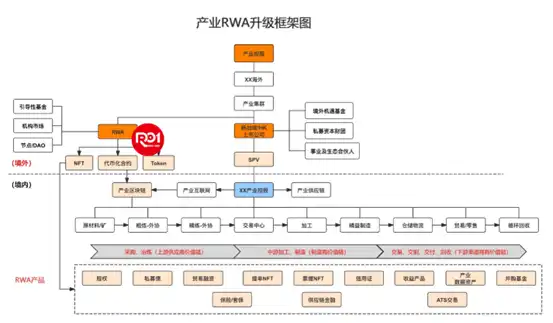
(Figure Traditional Manufacturing Industry RWA Upgrade Framework)
The advantage of traditional manufacturing lies in heavy assets (underlying assets and fixed assets) and the supply chain. Therefore, the RWA upgrade framework for the traditional manufacturing industry can be divided into four layers:
Layer one, RWA underlying assets, a distributed asset pool, including raw material mine assets, fixed assets, liquid assets, liability-type assets, and more; this involves the tokenization of underlying assets for RWAs, achieving asset on-chain pooling, distributed asset pools, dynamic pricing, etc.
Layer two, industrial chain space + industrial chain scenarios, revolving around the entire manufacturing industry chain of mining processing, international trade, supply chain finance, warehousing logistics, consumption, production, incentive scenarios, as well as core scenarios such as industry chain transactions and liquidity pools, all have opportunities for RWA tokenization.
Layer three, industrial finance (Defi) and industrial stablecoin + PayFI, industrial stablecoins and industrial payment settlement and investment and financing scenarios, as well as encrypted smart finance based on industrial RWA assets for lending, futures, insurance, etc.
The fourth layer, RWA Industry Trading Platform, the upgraded ultimate will inevitably be an industrial RWA trading platform, with exchanges or top-tier exchange's vertical track platform and platform token.
Around traditional industrial upgrades, it will face the transformation issue of digitization and chain-based asset transformation.
This foundational work can simultaneously start with RWA financing to drive infrastructure development, mainly achieving the industry's "controllable assets + trusted asset management," where controllable is for on-chain tradability, deliverability, or control of delivery; trusted asset management involves industrial asset tokenization fundraise management, asset issuance, trading/investment, management, and exit.
For industrial upgrades, for the institutional market, the core is corporate credit, where RWA's controllability and trustworthiness are similar to the on-chain credit mechanism or Oracle mechanism.
Thus: RWA, for a company, is a bond issuance; for an industry, it is a new platform for assets and funds; for a region or country, it is a digital asset, stablecoin, and cryptographic financial system.
#ARAW Always RWA Always Win!
By 2025, the RWA market will rapidly find its place amidst rapid growth. In the new year, Kai will officially start recruiting disciples to mentor and guide. Young talents aspiring to the RWA direction are welcome to take the lead.
More and more friends are coming to ask specific project questions, which cannot be answered in detail on WeChat. A disciple class and practical study camp will be launched soon, so come to the classroom to diligently comprehend, interact, and conduct sandbox scenarios. You can add WeChat YekaiMeta to join the RWA Industry Research Group for discussions.
This article is a contribution and does not represent the views of BlockBeats.
You may also like

The large models in the United States are moving towards closure in the name of security

Morning Report | CoinEx becomes a key hub for Iran to evade sanctions, involving over $3.8 billion in funds; Kalshi seeks a new round of financing, with a valuation potentially rising to $40 billion

From the white-haired stock god to the billionaire fund mogul, the smart people shorting Nvidia are all getting rich using the same framework

Why do cryptocurrency projects always like to change their names?

Global Launch: As predictions become the most scarce asset in the AI era, Manadia is defining the next generation of the value internet

Who is footing the bill for the $64 billion accounting frenzy?
I never expected that the first application of AI x Crypto would be in security auditing

What is your view on Binance's competitive advantages?

ETH has entered a non-consensus phase, and the turning point is approaching!
The shift in the cloud of the air: from despising stablecoins a year ago to the high-profile entry of capital today
The survival dilemma of small and medium exchanges behind the withdrawal anomalies exposed by AscendEX
Why Is Bitcoin Falling Below $60K? 5 Key Market Drivers Explained
Bitcoin has dropped sharply amid ETF outflows, Strategy stock weakness, AI stock rallies, and changing Fed expectations. Explore the key forces driving BTC’s latest correction and what traders should watch next.

Bitcoin vs. Gold in 2026: Which Asset Performs Better in Different Markets?

Morning News | The draft amendment to the People's Bank of China Law aims to clarify the legal status of digital renminbi; South Korea will transfer about 40 unregistered virtual asset service providers to law enforcement agencies
The cryptocurrency industry has entered the "Show Me" era: merely relying on vision is no longer enough

Interpreting the Ethereum Foundation's new structure: Reaffirming self-sovereignty amid institutional trends
Former SpaceX engineer reconstructs the financial execution system using first principles
Standard Chartered Bank sings a 50x rhapsody again, aiming for AAVE to reach 3500 USD
The large models in the United States are moving towards closure in the name of security
Morning Report | CoinEx becomes a key hub for Iran to evade sanctions, involving over $3.8 billion in funds; Kalshi seeks a new round of financing, with a valuation potentially rising to $40 billion
From the white-haired stock god to the billionaire fund mogul, the smart people shorting Nvidia are all getting rich using the same framework
Why do cryptocurrency projects always like to change their names?
Global Launch: As predictions become the most scarce asset in the AI era, Manadia is defining the next generation of the value internet
Who is footing the bill for the $64 billion accounting frenzy?


