
「Leading Lady」 Noble Leaves the Stage, Is the Cosmos Ecosystem Now a 「Hollowed Shell」?

 Prefer us on Google
Original Title: "Noble Leads the Way Out, Another Solid Confirmation of 'Cosmos Is Dead'?"
Original Author: Sanqing, Foresight News
On January 20, Cosmos application chain Noble, focused on stablecoins, announced that it would migrate from the Cosmos ecosystem to an independent EVM L1 network. The Noble EVM is scheduled to launch on March 18, and the team will continue to support Cosmos-based blockchains in the short term. After the migration, Noble's own USDN stablecoin will become a core feature of the EVM L1, with the NOBLE token serving as a governance asset, closely tied to protocol decisions and the usage of stablecoins across the entire network.
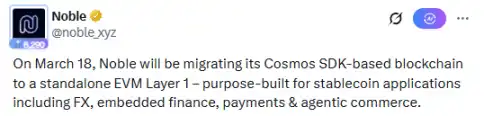
Image Source: Noble Twitter
Subsequently, the founder of Cosmos responded in a post, stating that Noble's transition is not a deviation from the vision of Cosmos, but rather an embodiment of the core concept of "sovereignty and interoperability." Noble's migration does not mean a disconnect from the Cosmos Hub. Instead, through the IBC v2 protocol, the migrated Noble EVM will become a key bridge connecting the EVM ecosystem with the Cosmos economy. He stated, "We are entering an era not defined by chains, but by liquidity."
Cosmos's Stablecoin Ace, Why Choose to Exit?
Noble is one of the most successful stablecoin infrastructure projects in the Cosmos ecosystem. It is the chain that natively issued Circle's USDC to the Cosmos ecosystem, distributing USDC securely and frictionlessly to 50+ chains through IBC, processing over $22 billion in transaction volume to date.
Noble's presence has given the Cosmos ecosystem a competitive edge with a "native stablecoin" and has avoided reliance on trust risks from external bridges.
But why did Noble choose to migrate? The reason given by the Noble team is very practical:
The EVM ecosystem is overwhelmingly dominant. Over 75% of the stablecoin market is on EVM chains. Developers, tools, wallets, dApps are all concentrated on EVM, and since Noble aims to be the "L1 stablecoin infrastructure," it naturally has to follow the money and people.
The EVM technology stack is more developer-friendly. The EVM has a mature toolset including Solidity, Remix, Hardhat, etc., making it easier to integrate protocols like Uniswap, Aave. Although the Cosmos SDK is powerful, it has a steep learning curve, and its ecosystem tools are relatively behind.
The EVM has better performance and real-world use cases. Noble EVM aims for sub-second latency, targeting scenarios such as payments, embedded finance, agentic commerce, FX, etc. While Cosmos' Tendermint consensus is reliable, the EVM stack can better align with mainstream payment chains.
Noble has its own strategic ambitions. Noble doesn't want to be just a "workhorse" within Cosmos but aims to become an independent high-performance stablecoin Layer 1, directly competing with other stablecoin public chain projects.
Therefore, Noble voted with its feet. Cosmos provided the initial groundwork, but the EVM offers it a scalable future.
Noble's Departure Took Away Cosmos's "Half-Life"
Noble is Cosmos's only "super giant." Noble's 30-day IBC transaction volume reached USD 93.84 million, which is 1.8 times that of the second-ranking Osmosis (USD 50.06 million). Within the 110 Zones linked by Cosmos IBC, Noble contributed at a ruptive level of liquidity.
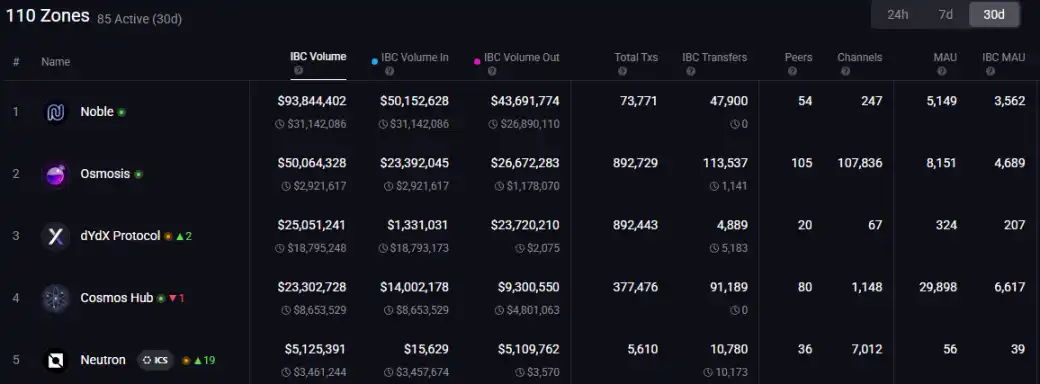
Image Source: MAP OF ZONES
Noble is the "faucet" for institutional funds. Osmosis has nearly 900,000 transactions, while Noble has only 73,000. This means that Noble's single transaction value is much higher compared to other chains. It handles institutional-level stablecoin settlements and large-scale distributions, not retail-level small exchanges.
Although there are 110 linked Zones through IBC, only 85 are active. This indicates that 23% of the chains are already in a state of death. Liquidity is highly concentrated in the top four chains, while projects outside the top ten have seen their monthly transaction volumes shrink to the million-dollar level, and the ecosystem's retail vitality is severely overdrawn.
The Cosmos Hub has approximately 30,000 monthly active users, which is six times more than Noble (around 5,000 people). However, the money actually flows to Noble. Most Cosmos users mainly stake or observe on the Hub, whereas the stablecoin activities that truly generate value are almost solely dependent on Noble.
The Soul of the Cosmos Ecosystem: How IBC Powers the "Blockchain Internet"
The core narrative of Cosmos is the "Internet of Blockchains" — an internet of blockchains, with IBC (Inter-Blockchain Communication Protocol) being the technology that makes this vision a reality.
IBC is Cosmos's most unique and successful invention. It enables independent sovereign chains to securely and trustlessly communicate and transfer assets to each other, similar to TCP/IP on the internet. Its key features include:
Minimal Trust: Verifying the state of the counterparty chain through light client validation, without the need for asset custody or multi-signature bridges.
Permissionless Interoperability: Anyone can create a channel to support token transfers, Interchain Accounts, Interchain Queries, and more.
Universality: Agnostic to consensus mechanisms, already connected to 110+ chains (Map of Zones data), and expanding to non-Cosmos chains like Ethereum and Optimism.
IBC has demonstrated high security, never experiencing a large-scale exploit, with billions of dollars transferred cumulatively. Despite any controversies in other parts of Cosmos, IBC itself remains a top-tier interoperability solution in the industry.
However, Noble's migration also exposed an awkward aspect of IBC: while it interconnected the world, it couldn't retain projects — as everyone interconnected, they all wanted to dominate as a single chain on the EVM.
Exodus Confirmation: Which Cosmos Projects Have Died or Migrated by 2025-2026?
From 2025 to early 2026, the Cosmos ecosystem experienced a significant "project exodus/closure wave."
First, let's talk about the projects that have completely closed or ceased operations, with most of them having already perished by 2025, leaving only the community's regrets and sporadic maintenance attempts.
The privacy chain Penumbra has shut down completely, with the team exiting. While the chain is being reluctantly maintained by the community, it is mostly ignored, becoming the most typical example of complete closure. Pryzm has also shut down entirely, with Comdex and Kujira falling in succession, the latter even taking down sub-projects like Fusion and Levana, causing a fracture in the entire DeFi ecosystem.
Stride has formally sunsetted, ceasing operations; Quasar and Tower have successively perished, Picasso / Composable trapped users' SOL assets after a crash, leaving users empty-handed. Drop has abandoned its TGE and sunsetted, Milkyway has shut down, Demex failed to recover after a hack, Evmos has also essentially died.
These projects covered multiple tracks such as DEX, lending, privacy, NFTs, among others, mainly due to lackluster growth, insufficient revenue, team attrition, and the long-term aftershocks of Terra's collapse.
Meanwhile, some projects chose to migrate to non-Cosmos stacks or committed the ultimate betrayal to the Cosmos narrative. Except for Noble, Sei had also previously decided to abandon its dual-stack architecture in SIP-3 upgrade, planning to retain only the EVM chain by mid-2026.
Akash is migrating to Solana, while projects like Elys, pStake, Jackal, Omniflix are migrating to Base, Stargaze is forking to an independent chain and planning to migrate to the Cosmos Hub, Shade Protocol (rebranded Feather) first migrated to Sei, with potential further EVM-ization in the future.
The core motivation behind these migrations is almost unanimous: the developer tools, liquidity, and market size of the EVM ecosystem far surpass those of Cosmos; project teams are voting with their feet, choosing to follow the money and opportunities.
There is another group of projects that, while not dead, have entered maintenance mode or resource redirection, with slow project progress.
Osmosis has entered maintenance mode, still maintaining tokenomics and other updates, but with a noticeable outward shift in team resources and a significant drop in activity; Astroport is similar, essentially stagnant; after the Axelar team was acquired by Circle, the original project's influence sharply declined. These projects were once the pillars of Cosmos DeFi but have now become a microcosm of ecosystem contraction.
Mantra has undergone restructuring (January 2026 layoffs, cost optimization) and the OM token crash (nearly 99% drop), but the project is still advancing. The ERC-20 OM migration is underway, with RWA vaults, launchpad, and other features in development, and there will continue to be operations of an IBC-compatible RWA EVM L1.
Furthermore, a large number of DEXs such as Wynd, Hopers, Junoswap, Loop, TerraSwap, among others, closed in 2024-2025. Retail DeFi is basically cooling off, with only institutions and RWAs holding the fort.
The MAP OF ZONES shows IBC connecting 110 chains, but IBC traffic is heavily concentrated in the top few (Noble, Osmosis, Cosmos Hub), and once Noble's liquidity moves away, the entire ecosystem's vitality will be further diminished.
Although the Cosmos 2026 roadmap attempts to reverse the decline through EVM compatibility and high-performance upgrades, Noble's "walkout" undoubtedly reveals a harsh reality: in the face of liquidity, the technological narrative often appears feeble and inadequate.
Original Article Link
Disclaimer: This content is provided for general branding and informational purposes only and doesn't constitute financial, investment, legal, or tax advice. Any events, rewards, online events, or related information mentioned herein should not be considered a recommendation, solicitation, or invitation to purchase, sell, trade, or otherwise deal in any crypto assets or to use any services. Crypto assets are highly volatile and may result in loss. WEEX services and online events may not be available in all regions and are subject to applicable laws, regulations, and eligibility requirements. You are responsible for ensuring that your use of WEEX services complies with local laws and for carefully assessing the risks before participating in any crypto-related activities.
You may also like

Home Robot NEO Grows "Dexterous Hands": How Do Hands Become the API to the Physical World?

What is SCEX? The Cryptocurrency Exchange for Vietnam's Market by Sacombank
Major Update for ChatGPT: Cross-Platform Functionality, One-Click Website Creation, and Lower Costs

BTC Challenges 64,000 After Breaking 63,000, Market Trading 'Manageable Risks'
As the Bubble Bursts, Who Dominates Attention in the AI Era? A 2026 Guide to Influential AI KOLs in China and the UK

Old Money in Crypto Shifts: Paradigm Raises $1.2 Billion, Half Bet on AI and Robotics

Bitdeer unveils $36M Nevada factory to shake up Bitcoin mining
Perplexity Fine-Tuned a Chinese AI Model to Match Claude Opus 4.8 at One-Third the Cost

Bank of Korea defends bank-first stablecoin plan amid bill deadlock
JPMorgan says bitcoin's main risk isn't Strategy, but blockchain adoption that doesn't benefit public chains and tokens
Fear & Greed Index Today: What Extreme Fear Means for Crypto, Stocks and Gold
Labour MPs Push to Make UK Crypto Donation Ban Permanent
Supreme Court ruling expanding Trump's authority over federal agencies raises questions for SEC, CFTC as crypto rulemaking advances

'Bottom building in progress': Analysts say bitcoin holder capitulation signals late-stage bear market

A Comprehensive Analysis: Starting from 1996, Who is Laying the Foundation for the Next Generation of Capital Markets
Luke Dashjr, the Biggest Anti-Spammer of Bitcoin, Inscribed Phrases on the Network in 2011

Whales bought 270,000 BTC while ETFs bled $7 billion. One side is wrong

The crypto IPO class of 2025-26 is down as much as 89%. Autopsy of a listing boom
Robinhood Chain Mining Guide: A Comprehensive Tutorial from Cross-Chain to Memecoin
BitGo CEO says single-digit percentages of bitcoin's supply are 'probably right' for large holders amid Strategy's sale

Beyond Private Keys: How to Safeguard the Security Boundaries of Web3 from Wallets, L2 to Supply Chains?
Vanguard Enters the Market, Opening a New Crypto Gateway for 50 Million Traditional Investors

Why the OUSD Alliance of 150 Companies Still Cannot Shake USDT and USDC?
Citigroup Analysis: Is There Still 47% Upside for Nvidia? Can Rubin and CPO Deliver?
WEEX API Fast Connect: Turn Every Sign-In Into a Live Trader in Under 10 Seconds
WEEX API Fast Connect is a one-click OAuth authorization system that lets your users link their WEEX account without ever touching an API key. Frictionless onboarding, faster conversions, higher retention — built for WEEX Broker partners.
Bitcoin's dwindling exchange reserves don't pack the same bullish punch anymore

From Le Mans to the Rollercoaster: Carl Moon Takes On Portimão
Crypto world renowned KOL and racing driver Carl Moon, backed by WEEX, heads to the Ferrari Challenge Portugal round at the Algarve International Circuit, July 16–19, fresh off a podium finish at Le Mans. Here's why this race is one to watch.
Fast execution. Split-second accuracy. Security that never blinks. That's WEEX — and that's exactly how Carl races.

The Downfall of a Public Company: A $1.46 Billion Bet on WLFI, $540 Million Went to the Trump Family
Dragonfly Partner: BTC is Intergenerational Wealth, Optimistic About ETH and SOL
Goldman Sachs Calls to Go Long on Chinese AI: $4 Trillion Market Value Behind, Global Funds Only Allocated 1.2%
Home Robot NEO Grows "Dexterous Hands": How Do Hands Become the API to the Physical World?
What is SCEX? The Cryptocurrency Exchange for Vietnam's Market by Sacombank
Major Update for ChatGPT: Cross-Platform Functionality, One-Click Website Creation, and Lower Costs
BTC Challenges 64,000 After Breaking 63,000, Market Trading 'Manageable Risks'
As the Bubble Bursts, Who Dominates Attention in the AI Era? A 2026 Guide to Influential AI KOLs in China and the UK
Old Money in Crypto Shifts: Paradigm Raises $1.2 Billion, Half Bet on AI and Robotics
Contents
Latest articles









Latest coin listings on WEEX


